The Paternoster rig—often just called a side-leader or dropper rig over here—is one of the most effective setups you can tie for European perch. If you are already comfortable fishing a standard jig head or a Cheburashka rig, adding this to your arsenal will instantly increase your catch rate.
 By separating your sinker from your lure, the weight works along the bottom while your softbait flutters on a side leader. This simple tweak lets you cast micro lures to the horizon, fish them painfully slow, and keep them right in the strike zone.
When you see the angler in the next peg pulling out perch after perch while your rods stay quiet, they are probably using this setup. It absolutely shines when perch are passive. A standard jig drops like a stone, but a Paternoster rig lets your softbait hover and glide, triggering the predatory instincts of even the most sluggish fish.
In this guide, Fish Trail breaks down everything you need to know to tie and fish the Paternoster rig properly.
Why the Paternoster Rig Catches More Perch
If anglers are swapping out their standard jig heads for a side-leader setup, there is a good reason for it. It solves several real problems you face on the bank.
- Long-distance casting: You can bomb a tiny, weightless micro-plastic huge distances because the casting weight comes entirely from the heavy sinker.
- Reading the bottom: A heavy lead dragging the deck acts like a scout. With a bit of practice, you will easily feel gravel, silt, drop-offs, and weed beds to locate holding fish.
- Beating the wind: Trying to cast a 2g jig head into a headwind is a nightmare. With the Paternoster rig, a 15g sinker cuts right through the wind, taking your tiny lure with it.
- The slow fall: A twister on a standard jig hits the bottom in a second or two. On a side-leader, it sinks slowly and naturally. This extended “hang time” is what triggers passive perch.
- Beating the weed: If the bottom is covered in thick weed or blanket weed, a standard jig just buries itself. The Paternoster rig keeps your lure hovering safely above the vegetation.
- Forgiving tackle: Beginners often turn up with a stiff spinning rod better suited for pike. You cannot fish a 2g jig on a heavy rod—you just won’t feel it. But pop a 20g sinker on a Paternoster rig, and suddenly that heavy rod becomes a usable perch tool.
Tying the Rig: 4 Proven Setups
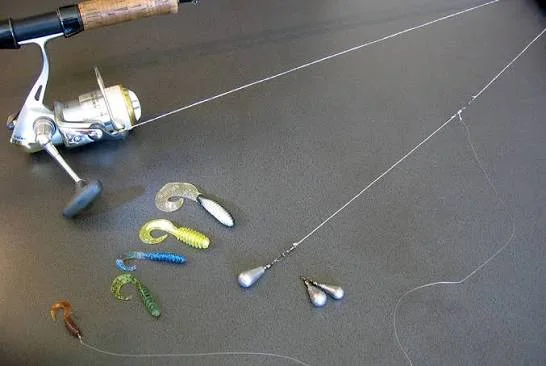
There are a few ways to build this rig. You can use a simple loop, add swivels to prevent twist, or create a sliding setup for maximum sensitivity.
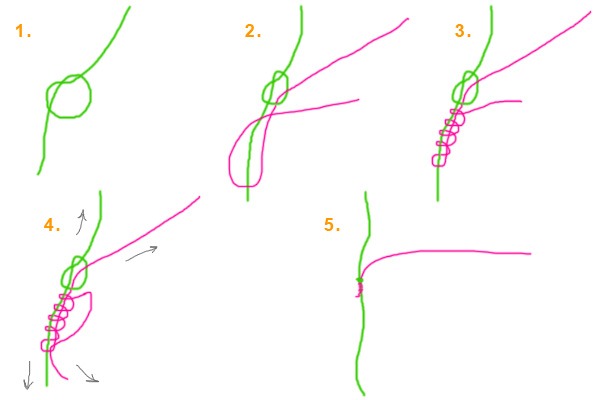
1. The Side Loop Rig
This is the most basic version. You tie it directly onto your main line without any extra hardware. It is fixed in place, meaning you cannot adjust the leader length without cutting the line.
- Tie your sinker to the end of the line.
- Tie a dropper loop about 20–30 cm above the sinker.
- Attach your 50–150 cm lure leader to the loop.
The downside: It twists heavily, especially on rivers. It is best saved for still waters or when you are completely out of swivels.
2. The Double Swivel Rig
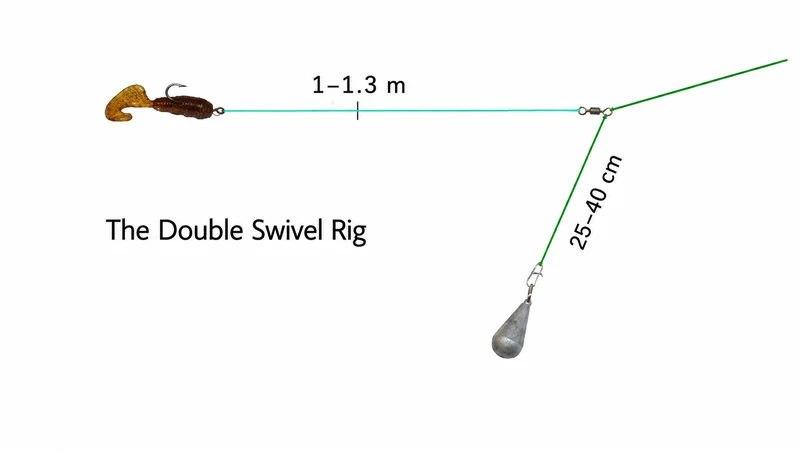
Adding a double swivel instantly reduces line twist and makes the rig much more reliable.
- Tie your main line to one eye of the swivel.
- To that same eye, tie a 20–30 cm mono leader ending in your sinker.
- To the other eye of the swivel, tie your 50–150 cm lure leader.
You will still get the occasional tangle on a bad cast, but it is a massive improvement over the basic loop.
3. The Three-Way (T-Swivel) Rig
Here, every line gets its own attachment point. Main line to the top, sinker leader to the bottom, and lure leader to the side.
Some anglers swear by T-swivels for a tidy setup. Others argue the bulky hardware creates unnatural vibrations in the water and prefer the double swivel. Try both and see which sits better with your casting style.
4. The Sliding Setup (Top Choice)
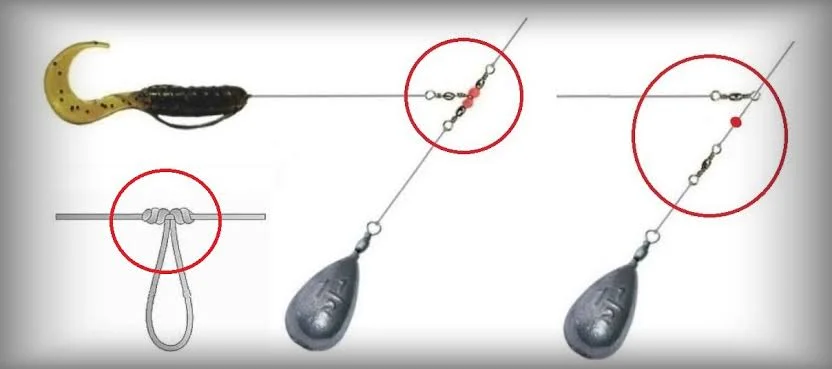
This is highly recommended by Fish Trail. Because the sinker slides freely on the main line, the fish feels zero resistance when taking the lure, and the tap travels directly up your braid to the rod tip.
- Thread a swivel onto your main line (this will hold your 20–30 cm sinker leader).
- Tie the end of your main line to a second swivel (this stops the first swivel from sliding off).
- Tie your 50–150 cm lure leader to the other end of that second swivel.
If you want to control how far the sinker slides up the main line, just add a rubber float stop above it.
Getting Your Tackle Right
You do not need to overcomplicate the gear, but balancing your setup is what makes this rig fish properly.
The Weights
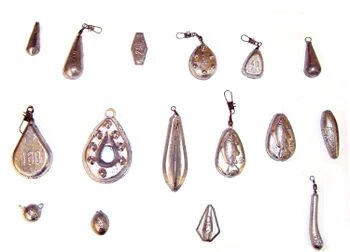 For a beginner, stick to weights between 10g and 30g. Base your choice on depth and flow. A shallow, still canal might only need 10g, while a fast river needs 30g to hold bottom.
Shape matters, too. Pencil or stick weights are brilliant for sliding through rocks and weed without snagging. Pear or drop weights offer better bottom contact. Always buy weights with built-in swivels to cut down on line twist.
The Hooks
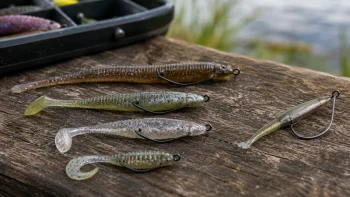 Small offset hooks (around size 8) are perfect, especially since perch lures are small. Rigging your softbaits weedless on an offset hook saves you from constantly snagging debris. If you are fishing a perfectly clean, sandy bottom, a standard long-shank single hook works fine, but an offset is always the safer bet for clean, ethical hooksets.
Lines and Leaders
- Main Line: Thin braid is non-negotiable for bite detection. Something around 0.10mm to 0.16mm is ideal. Braid has zero stretch, so you feel every stone and every pluck.
- Sinker Leader: Use standard mono. Make it slightly weaker than your main line so if the lead gets wedged in rocks, you only lose the weight, not the whole rig. Keep it around 20–30 cm.
- Lure Leader: Fluorocarbon is the best choice here. It is virtually invisible in water and much stiffer than mono, which massively reduces tangles during the cast. A diameter of 0.20mm to 0.25mm is perfect.
Quick Tip on Leader Length: If the perch are actively hunting, a short 50 cm leader gets the lure down quickly. If they are sulking, lengthen it to 1 m or even 1.5 m for a painfully slow, natural fall.
The Rod
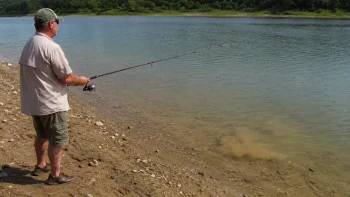 Look for a fast-action spinning rod around 2.4m to 2.7m with a casting weight of 5–35g. You need a rod that can handle chucking a heavy lead but has a responsive enough tip to impart tiny twitches to the softbait. If you are fishing from a boat, scale down to a 2.1m rod for easier handling.
4 Ways to Work the Paternoster Rig
Do not just cast out and wind in. How you retrieve the rig determines how many fish end up in the net.
1. The Basic Lift and Drop
Cast out and let the lead hit the deck. Wait 2–3 seconds for the softbait to flutter down behind it. Hold the rod at 10 o’clock. Flick your wrist to pop the rod up to 11 o’clock, then drop it back to 10 o’clock while picking up the slack line. Experiment with the sharpness of the lifts based on the fish’s mood.
2. The Bottom Drag
This requires patience but is deadly. Let everything sink, then slowly turn the reel handle a quarter or half-turn. Pause, then repeat. The lead drags through the silt, kicking up a mud cloud, and the lure trails right through it. If you are on a river, you can just hold the rig in the current—the current will work the softbait for you.
3. Twitch and Pause
A favorite among match anglers. Keep a slow, steady retrieve on the reel, but constantly impart tiny twitches with the rod tip. Never let the line go completely slack during the pauses; perch love to smash the lure the second it stops moving.
4. The Matched Pull
This is a brilliant trick for active fish. Match the length of your rod pull to the length of your leader. If your fluorocarbon leader is 1 meter long, pull the rig exactly 1 meter, then pause. The sinker kicks up a cloud of debris, and because of the matched distance, your lure drops directly into that exact cloud. It perfectly mimics a small fish feeding on the bottom.
The Best Lures for the Job
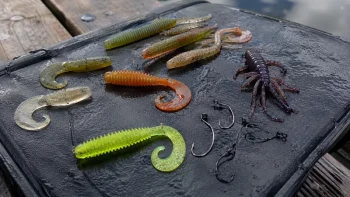 Softbaits are the undisputed kings of the Paternoster rig.
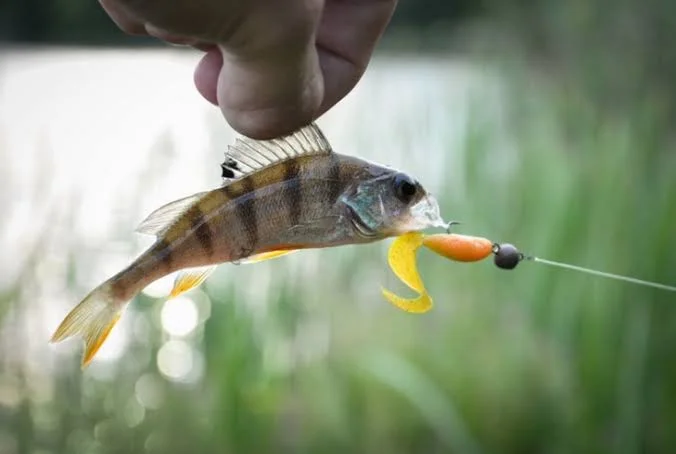
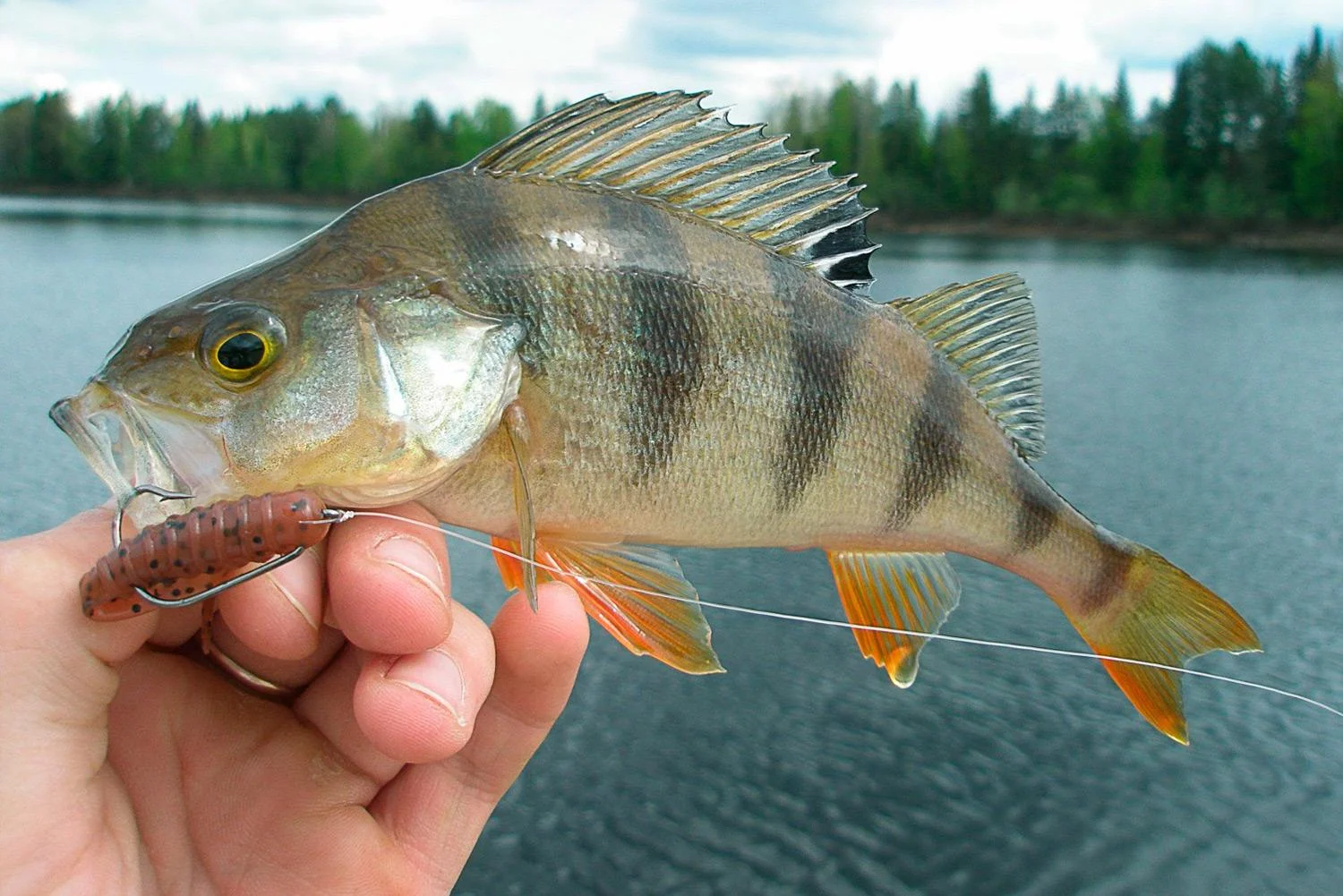
- Twisters (Grubs): The absolute classic. The curly tail works perfectly on the slow fall.
- Creature Baits (Craws/Nymphs): Excellent when dragged slowly to mimic crayfish or large larvae.
- Worms: Pin-tail worms twitch beautifully and trigger highly passive perch.
Stick to scented/salted softbaits if you can get them. When a perch inhales a salted, flavored lure on a slack line, it hangs on much longer, giving you that vital extra second to strike.
Tie one up on your next session. Once you get a feel for bouncing the lead and watching the rod tip wrap around on the pause, it will become a permanent fixture in your tackle box.