The first cast along the reeds comes back clean. A metre further out, the same bait comes back with both hooks wrapped in weed. You can move back onto the clean strip or keep the bait above the weed where you want to fish. Adding a float to your bottom rig won’t do the second job on its own.
Use a running leger to lay a deadbait on clean ground, a float leger to anchor it there and watch the take, or a float paternoster to hold it just above low weed. Here’s how to put each one together and check where the bait has actually settled.
Which Pike Deadbait Rig Should You Use?
| What you’re fishing over | Rig to start with | Where the bait sits |
|---|---|---|
| A clean patch you can’t watch closely with a float because of wind, chop or distance | Running leger | On the bottom. Watch a rear drop-off indicator and use an audible alarm. |
| A clear margin or shelf where you can see a float settle and move | Float leger | On the bottom. The float shows the take; a rear drop-off indicator backs it up. |
| Low weed or leaf litter with a clear route to bring a fish back | Float paternoster | Above the bottom. The float supports the bait branch while the lead anchors the rig below it. |
On an unfamiliar swim, make a short cast with a plain lead and no hooks. Draw it back across the area you want to fish. A lead that pulls smoothly tells you more than a clear-looking surface, but the first baited retrieve is the real check: fine weed can still catch on exposed hooks. If the only route back crosses thick stems or submerged branches, move to a swim where you can land the fish.
Get the Wire and Hooks Right Before You Cast
There are two pieces of wire in each of these rigs. The hook trace carries the hooks. The uptrace runs above it, between the hook trace and the main line. If the bait swings back on the cast, that extra wire helps keep a taking pike’s teeth away from the main line.
- Hook trace: Start with at least 45 cm (18 in) of wire rated at 30 lb or more. For a whole deadbait on a two-hook trace, sizes 4-6 are a useful range where trebles are allowed. Match the spacing to the bait so neither hook is pulled out of position.
- Uptrace: Use at least 60 cm (24 in) of 30 lb or stronger wire for these rigs, and choose a longer one if you lengthen the hook trace. Check with the bait fitted: folded back against the uptrace, the bait and hooks should stay below the main line. Use a strong link swivel to join the two traces.
- Main line: The Pike Anglers’ Club code of conduct recommends at least 18 lb mono or 65 lb braid as an all-round guide. Check the fishery’s rules for line, hooks and permitted deadbaits.
For a legered whole bait, nick the treble nearest the swivel through the firm root of the tail and put the second treble no further forward than the dorsal fin. On semi-barbless trebles, use the barbed point to hold the bait and leave the other points clear. If you’ve cut the bait down to a mackerel tail section, use a trace with closer hook spacing rather than bunching the bait up to fit.
Running Leger: Fish a Clean Patch on the Bottom
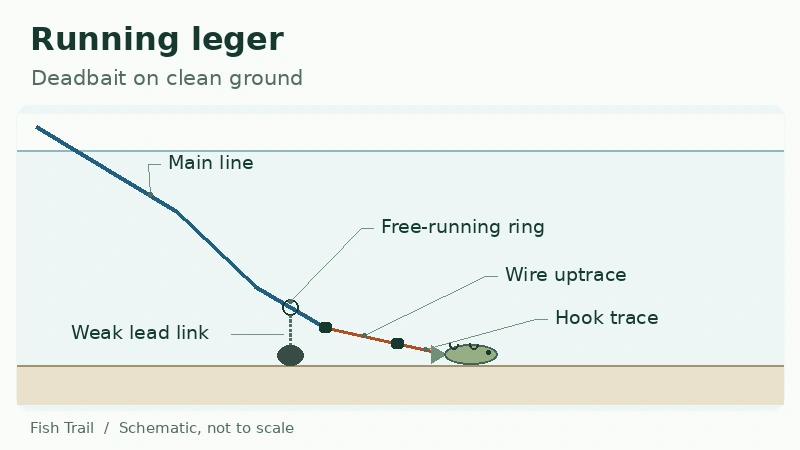
If you’ve found clean ground and the wind would make a float a nuisance, start here. The line pulls through the run ring when a pike moves off, so the fish doesn’t have to drag the lead to show a take.
- Thread a large-eye run ring onto the main line. Attach a lead to the ring on a short weak nylon link. If you use a buffer bead between the ring and the knot, check that the ring can pass over the bead and the top swivel of the uptrace. Don’t add a stop that traps the lead.
- Tie the main line to the top swivel of the wire uptrace and clip the baited hook trace to the bottom. Before casting, hold the lead still and pull the trace. The line should feed through the ring without moving the lead or catching on a fitting.
- After the cast, let the lead settle and wind in the slack without shifting it. Set a rear drop-off indicator between the reel and butt ring, with the bail open or the reel in free spool. Check the whole setup with a pull on the line: the indicator should release cleanly and the line should feed freely.
In sheltered water, a 1 oz (28 g) lead is a reasonable first try. If tow or flow moves it, go up a size or fish a softer seam. Count the bait and rig as well as the lead when judging the total casting weight. If the lead holds but the hooks come back green, change the spot or lift the bait with the paternoster. A bigger lead won’t clear the hooks.
Float Leger: Watch a Bait Fished on the Bottom
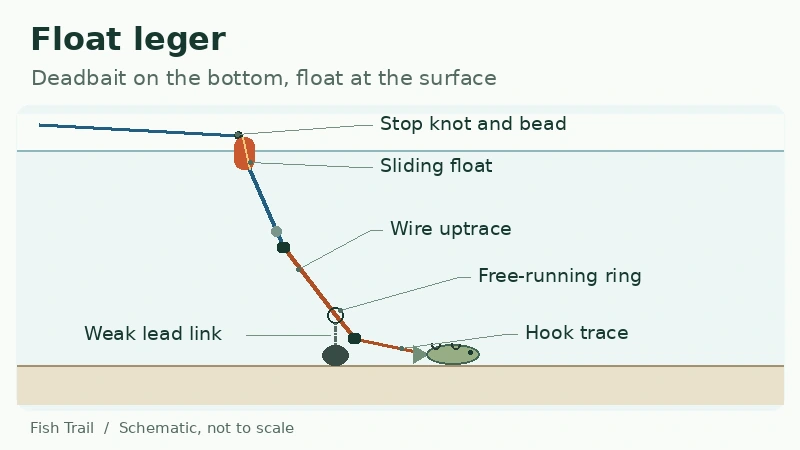
On a quiet margin, a float leger shows changes you can see before you hear an alarm. The bait still lies on the bed. If you want a bait to hang under the float without a lead anchoring it, use a suspended sliding float rig.
- Working down from the rod, fit a sliding stop knot, a small bead that can’t pass through the float, and a through-body slider. Add a protective bead below the float, then the large-eye run ring and weak-linked lead. Tie on the wire uptrace and clip on the hook trace. Check that the ring runs past the top swivel onto the wire and that the lead can shed without being trapped by the fittings.
- With the hook trace unclipped, plumb the exact spot you’ll fish. Use an anchor lead heavy enough to sink the float when suspended. Start with the stop set just over depth, so the lead can reach bottom. Slide the stop away from the float to fish deeper or towards it to fish shallower.
- Clip on the baited trace and recast. Once the lead settles, take up slack gently until the float sits in a repeatable position without shifting the lead. Watch it and set a rear drop-off indicator as backup. The float’s settled position is your reference for a take.
If the float lies flat before you tighten, that can simply be slack. If it still won’t cock after you take up slack, shorten the depth a little and recast. If it sinks every time the lead drops, increase the depth and check again. On a sloping shelf, plumb again when you change range. If the depth is right but wind repeatedly drags the rig off the spot, go back to the running leger.
Float Paternoster: Anchor a Deadbait Above Low Weed
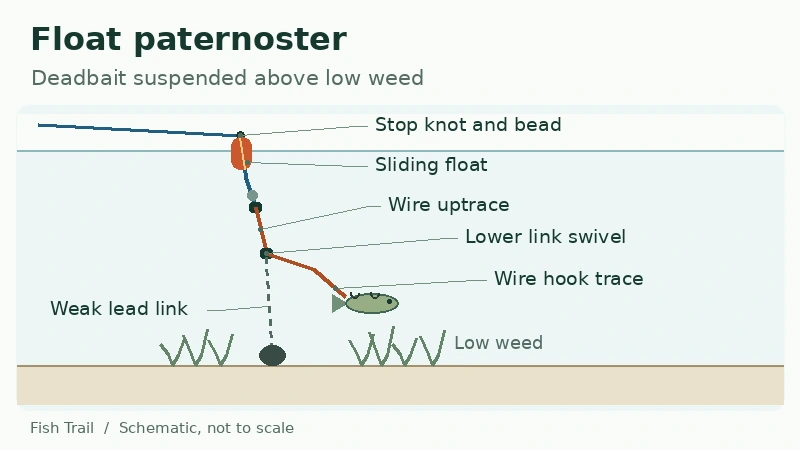
The difference is at the bottom of the uptrace. The bait comes off a junction, and the lead hangs from a separate, longer link underneath. The float holds the junction up while the lead stays on the bed. Start with a sheltered swim and low weed; in strong tow, the line can lean far enough for the bait to drop back into the weed.
- On the main line, fit the stop knot, top bead, through-body slider and protective bead. Tie the line to the top swivel of the uptrace.
- Clip the wire hook trace to the link swivel at the bottom of the uptrace. Tie a separate weak nylon lead link to the lower eye of that same swivel. As a starting point, pair a lead link of about 90 cm (36 in) with a 45 cm hook trace. Use nylon substantially weaker than your main line for the lead link; about 6 lb is a starting point for a gentle cast in a sheltered swim. Choose a lead heavy enough to anchor the rig against the pull of the float.
- Plumb the spot, then set the stop so the lead rests on the bed with the float supporting the junction. Before the first proper cast, lower the baited rig into a clear margin deep enough to see it hang. Check that the lowest part of the bait and the hooks clear the bottom, and that the float supports the bait without lifting the lead.
That 90 cm is the lead link, not the bait height. The bait hangs down from the junction, and the setup leans in tow. If the first retrieve still brings back weed, lengthen the lead link and reset the stop, then check again. If you’re fishing water too shallow to keep the wire and branch properly extended, or the rig keeps tangling, choose a clean strip or fish a suspended slider instead.
What a Take Looks Like and When to Strike
Watch for a change from how the rig settled. A float that lifts, lies flat unexpectedly, slides steadily across the surface or pulls under can signal a take. On a leger, a pike swimming towards you can slacken the line and drop the rear indicator without a sustained run on the front alarm. That’s a drop-back, and it needs the same response as line peeling off the reel.
On a positive indication, pick up the rod, close the bail or engage the reel, wind down and set the hooks as soon as you feel the fish. Don’t wait for a second run. If you can’t read the rig reliably in the conditions, reel in and reset it or switch methods.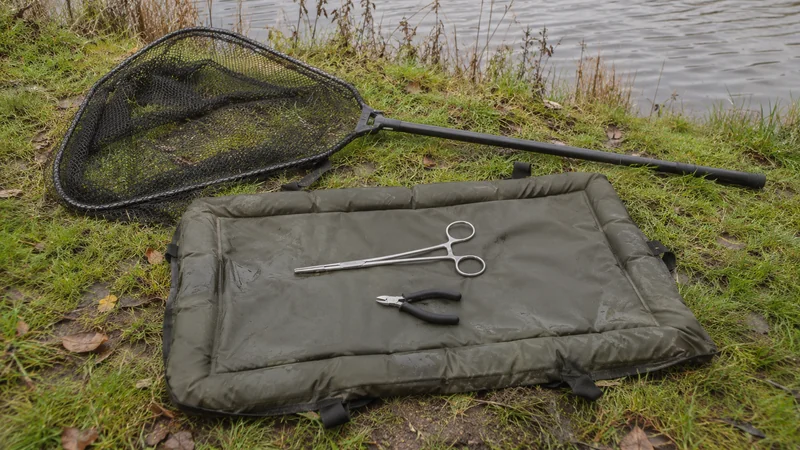
Set out a large knotless net, a padded mat, long forceps and hook cutters before baiting up. If you haven’t unhooked a pike before, go with someone who can show you. Stay beside the rod and reel in before leaving the swim.